Taking Research and Development Tax Credits
OUR BLOG Our Published Article Back to Articles February 2019 JAMIE HERZLICH View Article PDF Link...
As the global market increasingly evolves towards a digital economy and online shopping, it is anticipated that warehouses and distribution centers will turn towards more automation. Distribution center automation is becoming one of the greatest supply chain trends of 2017. New Jersey is the major distribution center hub for the nation’s most populous markets. Today, companies engaging in research and development efforts to explore warehouse and distribution center automation are eligible for lucrative R&D Tax Credits.
The Research & Development Tax Credit
Enacted in 1981, the federal Research and Development (R&D) Tax Credit allows a credit of up to 13% of eligible spending for new and improved products and processes. Qualified research must meet the following four criteria:
Eligible costs include employee wages, cost of supplies, cost of testing, contract research expenses, and costs associated with developing a patent. On December 18, 2015, President Obama signed the bill making the R&D Tax Credit permanent. Beginning in 2016, the R&D credit can be used to offset Alternative Minimum tax and startup businesses can utilize the credit against $250,000 per year in payroll taxes.
Understanding Distribution Center Automation
Companies that offer their products online are challenged with recent consumer demand increases as online shopping becomes more popular. To remain competitive in the market, these companies are “hiring” robots to fulfill some of the tasks human laborers are overburdened with in warehouses and distribution centers.
In warehouses, the most time consuming activity is picking products from shelves once an order is placed. The most effort in this operation consists of the traveling required to pick up the product and bring it to the next location. Workers walk miles a day to pick and pack items from shelf to box. With the use of robotics, that traveling task can now be fulfilled by a robot. Many robots in these settings transport products on the floor, saving time which would have been spent locating products to fill an order. Now, robots complete tasks of loading and unloading, retrieving and putting away, as well as pallet stacking. On a global scale, the International Federation of Robots (IFR) anticipates a 15% annual growth rate of robot implementation in warehousing and distribution center applications.
ASRS (Automated Storage and Retrieval System) technology is now being employed on a large scale to automate the entire picking process.[ii] ASRS includes computer-controlled systems that facilitate Inbound logistics. Warehouse automation: The next generation. January 27, 2016. Available at: http://www.inboundlogistics.com/cms/article/warehouse-automation-the-next-generation/ Global Cold Chain Alliance. Warehouse Automation Trends. Available at: https://www.gccaonline.com/eweb/documents/Warehouse-Automation-Trends.pdf robots to automatically place loads from defined storage locations. This results in more dynamic and accurate delivery to locations where pickers can retrieve from. ASRS eliminates extensive travel times required in the traditional, manual picking process. ASRS implementation has also paved the way for the creation of multi-level racking systems in which robo-carts can be instructed to only pick products on a certain level requested by an order.
One of the most tedious warehouse jobs is unloading and stacking. Fortunately, robots are designed to accomplish such tasks with built-in 3D vision sensors. These sensors help robots determine pallet sizes so they place larger pillars on the bottom and smaller ones on the top of a stack. It is anticipated that such robotic developments will not displace workers, however will instead help workers increase their overall efficiency.
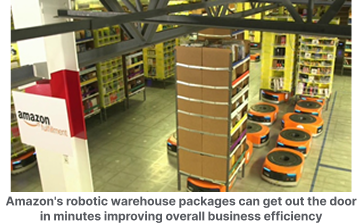
Kiva Systems, based in Boston, creates ground-based drones that deliver packages throughout warehouses and distribution centers. In most of its setups, Kiva incorporates custom shelving known as pods. These are mobile and flexible enough so robots can move them easily around a space. A Kiva installation also includes a grid of 2D QR code installed on the floor of the space, an intelligent pack station with scales, lasers, and sensors, and a software system that links these components all together. In 2012, Amazon Inc. bought Kiva for $775 million and has since deployed Kiva robots in its operations. Starting with 15,000 robots, it has since grown to 45,000 robots. Note that not all Amazon warehouses are now utilizing Kiva robot automation, however those that are have experienced significant expense reductions of 20%, or $22 million in savings per center. This comes as a direct result of increased efficiency. Before the robots, a typical cycle in an Amazon fulfillment center would take 60 to 75 minutes. With the robots, the cycle is reduced to 15 minutes, even though the inventory space expanded by 50%. Kiva pods have facilitated the space expansion and created more efficient use of the available space. These improvements are expected to continue as Amazon integrates more Kiva robots in its fulfillment centers.
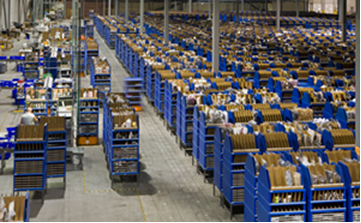
Clearpath Robotics Inc., based in Canada, created the OTTO robot with the goal of enhancing workflow in warehouses. OTTO is intended to relieve the burden of moving materials around so that human workers can devote their time to higher value activities. OTTO is a self-guiding robot that delivers goods around a floor space. Unlike Kiva’s robot, “OTTO’s intelligence allows it to ‘learn’ the warehouse landscape without the aid of a floor-guided track system.”[i] The robot can be told a point of interest and will navigate itself to that location at a constant, safe speed. Clearpath Robotics also makes other robots for land, air, and sea applications.
An October 2016 study conducted on warehouse priorities and investments found that almost 40% of interviewed warehouses were investing in automation from 2016 to 2019.[i] Those interviewed understood that e-commerce fulfillment is labor intensive and costly, and that the optimal way to deal with it is via automation. Furthermore, in the same study it was hypothesized that 3D printing will lend a hand in promoting development and adoption of robots and drones in warehouses and distribution centers.
The International Federation of Robotics (IFR) held a panel in 2016 to discuss the future trends of industrial robot installations from 2016 to 2019. It is anticipated that during this time period, human-robot collaboration will grow and becoming more beneficial than previously anticipated. The top 5 nations with expansive robotic applications include China, Japan, United States, South Korea, and Germany. Continued growth in expected for the US, with 5% to 10% per year growth from 2016 to 2019.
Investments in warehouse and distribution center automation provide significant R&D Tax Credit opportunities to those engaging in such activities. Depicted below is a potential R&D Tax Credit scenario created by R&D Tax Savers:
| Potential Scenario: Collaborative Robot Purchasing |
|---|
| # of robots purchased | Cost per robot | Outside integration cost (50% of capital cost) | Resulting internal labor costs associated (estimate) | Estimate Federal R&D Tax Credit |
|---|---|---|---|---|
| 5 | $30,000 | $75,000 | $150,000 | $9,00 -14,000 |
| 5 | $50,000 | $125,000 | $250,000 | $15,000 – 24,000 |
| 10 | $30,000 | $150,000 | $300,000 | $18,000 – 29,000 |
| 10 | $50,000 | $250,000 | $500,000 | $30,000 – 48,000 |
Automation’s Impact on Future Jobs
The IFR affirms that increased automation will have positive impacts on labor demand. In fact, the warehouse robots “take over dull, repetitive tasks, and free up people to perform more value added work.”[i] Automation creates a chain effect in which one activity leads to the next.

Since January 2017, warehouse worker salaries increased 6% compared to the 2.8% increase seen in all other professions during this time frame. In March 2017, 945,200 jobs were accounted for in the warehouse and storage sectors alone. This marks a 5.3% increase from 2016. Just as Amazon is increasing its robot installations, it is also increasing its number of available positions. In April 2017, Amazon announced it was creating 25,000 more jobs for part-time workers.[i] Although some workers are concerned their salaries will decrease or they will lose their jobs, many companies that automate their warehouses are finding new ways to benefit their workers. They are being given new incentives and opportunities to increase individual output and efficiency. During holiday seasons, the part-time offerings are attractive to temporary workers, such as students.
Robots developed for warehouses are intended to work alongside human laborers. Known as collaborative robots, these robots will reduce the number of steps in a process that a worker would traditionally undergo to fulfill an order.In a collaborative setting, a worker may take a product off a shelf and put it on a rack that is led by a robot. The robot would then bring the product to workers at the next station, where they will be packaged and then shipped. Such advancements benefit the workers by increasing their productivity and efficiency.
Collaborative robots are already in high demand. In 2012, Boston-based Rethink Robotics Inc. introduced Baxter, a humanoid capable of kitting, packaging, loading, unloading, machine tending, and material handling.[i] Costing $25,000, Baxter is a viable solution for some businesses seeking to improve functionality and manufacturing processes.[ii] Rethink Robotics has started a new generation of industrial robots called Sawyer. This one executes many tasks that traditional industrial robots were incapable of. Sawyer is applied to CNC machining, PCB handling and ICT, metal fabrication, molding operations, packaging, testing and inspection, and loading and unloading Sawyer works collaboratively and safely alongside human workers.
Current Warehouse Automation
Many companies currently invest in warehouse automation in order to remain competitive in the digital economy.
UPS: UPS moves thousands of packages around every day. One of the UPS warehouses is located in Trenton, New Jersey. They are concerned with end to end distribution services from local to global shipping and delivery. The company is concerned with meeting delivery time as in their hub in Kentucky, with the use of robots, the center can handle over 84 packets per second, translating to over 416,000 per hour. This helps it deliver on time and maintain customer satisfaction levels.[i] Robots have replaced ¾ of the warehouse jobs
IKEA: Considered one of the leading “speed” furniture companies in the world, IKEA gains this title in part from its automated warehouses. Located in Paramus New Jersey, they have automated storage and retrieval systems that capitalize on warehouse space. As a result, they can store even more products. At peak efficiency, 13 cranes that comprise one warehouse, for example, can move over 600 pallets per hour.[ii] This translates to almost one pallet per minute per crane. Storing, processing, and shipping are faster now than in the past. Orders are completed within 24 hours, when in the past, it would take over 72 hours per order.
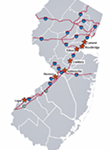
Amazon: Amazon delivers millions of products to people all around the world and has been expanding their warehouses throughout New Jersey for example in Middlesex County and in Burlington County. Amazon’s key operations are run on automation with more than 13,000 employees. There are 14 miles of conveyor belts which consist of a mix of employees and robots providing an efficient network to efficiently order, package and ship the order. The installation of the Amazon Prime hubs has provided customers with a faster option of receiving their orders. Amazon Prime creates a lean and cost efficient network that is difficult for competitors to supersede. Amazon has made their shipping even faster and more convenient for their customers. As the image below depicts, the Amazon facility locations spread throughout New Jersey.
FedEx: FedEx services 2.4 million packages requests per day to locations all over the world. The company makes sure to deliver the goods in a timely manner and decreases transportation and warehouse costs. The faster the inventory turns then the increase in cash flow for the company.[i] FedEx has distribution hubs in New Jersey and looks to continually improve their goods to increase customer satisfaction.
Wal-Mart: Wal-Mart has distribution centers in Vineland, New Jersey. Large warehouse facilities are used to help with their online e-commerce business as it enables companies to deliver packages more economically when shipping. The warehouse uses a number of robots to pick, pack and sort items. The use of robots has sped up the delivery time by 15%[i] over the last two years by using an algorithm to locate and sort items. Wal-Mart employees are still an important part of the process. Wal-Mart offers 5 million products online which include the iPad which is one of the top selling items. Over the past 4 years, Wal-Mart has increased its investment in e-commerce and digital initiatives from about $300 million in 2013 to $1.1 billion this year for a total of about $3 billion according to public filings and earning transcripts. E-commerce is about 3% of Wal-Mart’s overall sales.
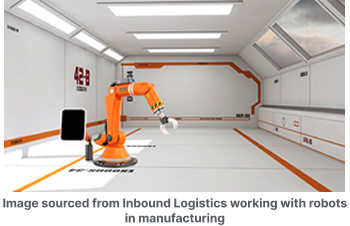
Boxed: Bulk grocery e-commerce start-up Boxed is located in Trenton, New Jersey. The warehouse introduced robots that replaced ¾ of the warehouses jobs. The “ibots” robots provide security, precision and efficiency for the company. The company retained the employees whose jobs were replaced by robots since they brought loyalty and held the company’s culture together. Boxed demonstrated that as important robots are in manufacturing people are an asset to the company.
Conclusion
Recent developments in robotics have enabled widespread adoption of robots in warehouses and distribution centers. These robots are intended to work alongside existing warehouse workers to handle tedious, time-consuming tasks that often deter people from seeking out these types of jobs in the first place. This warehouse and distribution center automation creates new avenues for improved productivity and efficiency.
New Jersey distribution centers handle tremendous volumes and can benefit greatly from automation which offers opportunities to remain competitive and increase efficiencies. These automation integrations require companies to keep up with the constant revolutionizing of e-commerce. In addition, as consumer demand constantly changes, businesses must predict the future of the digital economy to maintain a competitive edge.
Companies engaging in the development and integration of warehouse and distribution center automation are eligible for Federal and State R&D Tax Credits to help support and stimulate these efforts.
OUR BLOG Our Published Article Back to Articles February 2019 JAMIE HERZLICH View Article PDF Link...
OUR BLOG Our Published Article Back to Articles March 2018 By Charles R. Goulding View Article...
OUR BLOG Our Published Article Back to Articles June 2021 By Charles R. Goulding View Article...
OUR BLOG Our Published Article Back to Articles August 2017 By Charles R Goulding, Chloe Margulis, and Lara Tomiko Link...
OUR BLOG Our Published Article Back to Articles August 2015 By Charles R. Goulding and Jennifer Pariante Charles R. Goulding...
OUR BLOG Our Published Article Back to Articles July 2016 View Article PDF Tags Related Articles edit post R&D Tax...
Charles R. Goulding is an Attorney/CPA, President and founder of Energy Tax Savers/R&D Tax Savers, two divisions of a national tax consulting firm. Previously, he was a Managing Director at Cooper Industries Inc. (now Eaton) in Houston, Texas. Before joining Cooper, Mr. Goulding was a vice president of Dover Corporation, an eight billion dollar sales NYSE diversified industrial manufacturer. At both companies, Mr. Goulding created and administered company-wide R&D Tax Credit programs. These programs encompassed both domestic and international business operations and have helped generate over $600 million in tax savings for their respective firms. Mr. Goulding has been at the forefront of R&D Tax Credit work since the credit’s inception in 1981.
Mr. Goulding has a law degree from Brooklyn Law School (Juris Doctor) and an MBA from Adelphi University. Mr. Goulding also participated in Pace University’s Doctor of Business Administration Program. His undergraduate degree is from the State University of New York at Stony Brook where he was a double major in Political Science and Economics. He spent his junior year abroad at the University of Copenhagen, Denmark.
Mr. Goulding is a former President of the New York Chapter of the Tax Executives Institute and also participated in Pace University’s Doctor of Business Administration Program. He has served as the co-chairman of the Taxation of Mergers and Acquisition conferences in Chicago, Houston, New York City, San Francisco and Paris, France. He recently chaired New York’s Solar Investment Conference.
He has authored over 800 articles for numerous tax publications including International Business, International Tax Journal, Euromoney, Taxation for Accountants, The Practical Accountant, The CPA Journal, and Corporate Business Taxation Monthly.
Mr. Goulding successfully litigated the Dover Corporation case in U.S. Tax Court (the first check the box case) and the Pulsar International case on reasonable compensation. He is also the Mayor of the Village of Oyster Bay Cove, New York
Jacob Goldman, LEED AP, is Vice President and Chief Engineer of Energy Tax Savers/R&D Tax Savers. Since co-founding the Company in 2005, Mr. Goldman has helped secure over a billion dollars in tax deductions across 17,000+ projects. His expertise includes R&D Tax Credits and energy related incentives such as Section 179D and Investment Tax Credits under the Inflation Reduction Act (IRA).
Mr. Goldman is an award-winning speaker, distilling intricate tax codes into actionable strategies. He frequently presents at national conferences like AEE, IGSHPA, LightFair, and NFMT, as well as local chapters of USGBC, ASHRAE, IFMA, BOMA, and beyond. His most recent accolades include the 2023 AEE Northeast Regional Award for Energy Professional Development.
His thought leadership has played an integral role in advising the DOE, NEMA, and NRDC on Section 179D extensions. He has pioneered the firm’s national practice for IRA incentives, from universities leveraging solar tax credits to corporations optimizing energy efficiency deductions, Mr. Goldman’s expertise is at the cornerstone of sustainable tax strategy.
Mr. Goldman has authored over 150 articles in leading industry publications including Corporate Business Taxation Monthly, Building Operating Management, Thomson Reuters, Green Lodging News, and International Parking Institute.
With a BS in Chemical Engineering from the University of Buffalo and an MBA from the University of Maine, Mr. Goldman brings a rare blend of technical mastery and financial acumen to the complex world of tax optimization.
Charles R. Goulding is an Attorney/CPA, President and founder of Energy Tax Savers/R&D Tax Savers, two divisions of a national tax consulting firm. Previously, he was a Managing Director at Cooper Industries Inc. (now Eaton) in Houston, Texas. Before joining Cooper, Mr. Goulding was a vice president of Dover Corporation, an eight billion dollar sales NYSE diversified industrial manufacturer. At both companies, Mr. Goulding created and administered company-wide R&D Tax Credit programs. These programs encompassed both domestic and international business operations and have helped generate over $600 million in tax savings for their respective firms. Mr. Goulding has been at the forefront of R&D Tax Credit work since the credit’s inception in 1981.
Mr. Goulding has a law degree from Brooklyn Law School (Juris Doctor) and an MBA from Adelphi University. Mr. Goulding also participated in Pace University’s Doctor of Business Administration Program. His undergraduate degree is from the State University of New York at Stony Brook where he was a double major in Political Science and Economics. He spent his junior year abroad at the University of Copenhagen, Denmark.
Mr. Goulding is a former President of the New York Chapter of the Tax Executives Institute and also participated in Pace University’s Doctor of Business Administration Program. He has served as the co-chairman of the Taxation of Mergers and Acquisition conferences in Chicago, Houston, New York City, San Francisco and Paris, France. He recently chaired New York’s Solar Investment Conference.
He has authored over 800 articles for numerous tax publications including International Business, International Tax Journal, Euromoney, Taxation for Accountants, The Practical Accountant, The CPA Journal, and Corporate Business Taxation Monthly.
Mr. Goulding successfully litigated the Dover Corporation case in U.S. Tax Court (the first check the box case) and the Pulsar International case on reasonable compensation. He is also the Mayor of the Village of Oyster Bay Cove, New York
Raymond Kumar is a CPA and Director with Energy Tax Savers/R&D Tax Savers. He joined the firm in 2008 and brings with him Big4 accounting firm experience, where he helped secure specialty tax incentives for Fortune 500 automakers, defense contractors, and consumer goods manufacturers. His tax expertise includes Section 179D incentives and R&D Tax Credits which he has specialized in his entire professional career.
Mr. Kumar plays a key role in managing of the firm’s national Section 179D practice, working closely with clients and partners to identify and quantify tax savings. He is involved in every step of the process to ensure project success.
Mr. Kumar is a frequent author and presenter on tax incentives and has presented at the Human Centric Sustainability Event at Yankee Stadium, Energize Long Island conference, and the NYS Society of Professional Engineers Annual Conference. He has numerous published articles covering tax incentives, featured in Retrofit Magazine, Corporate Business Taxation Monthly, and FacilitiesNet.
Mr. Kumar holds a BBA in Accounting from Adelphi University and an MBA from NYU Stern School of Business. Mr. Kumar is a Certified Public Accountant (CPA), licensed to practice in New York.
Andrea Albanese is a Director with Energy Tax Savers/R&D Tax Savers. She joined the firm in 2010 and has played a key role in establishing and growing the firm’s national R&D Tax Credit practice. She oversees R&D Tax Credits and client relationships across a variety of industries including software, manufacturing, distribution, architecture and engineering, food and beverage, and aerospace/defense.
Ms. Albanese specializes in helping clients and CPAs identify, quantify, and maximize R&D Tax Credit benefits. She has helped secure tax credits for businesses ranging from start-ups to Fortune 500 companies, in both the public and private sectors. Her recent projects include a large e-commerce distributor, a London-based VR company, and a large manufacturer with multi-state operations. Her industry focus includes R&D Tax Credits for food and beverage production.
Her tax incentive expertise includes obtaining payroll R&D Tax Credits for start-ups as well helping clients obtain New York State refundable life science credits. She has numerous published articles covering tax incentives in leading tax publications such as Thomson Reuters and CCH’s Corporate Business Taxation Monthly.
Ms. Albanese holds a BS in Technology Studies from SUNY Farmingdale.
Lara Tomiko is a Senior Tax Analyst with Energy Tax Savers/R&D Tax Savers. She joined the firm in 2016 and has been involved with R&D Tax Credit studies across various industries, including architecture/engineering, food and beverage, renewable energy, horticulture, and control systems engineering.
Since the passage of the Inflation Reduction Act (IRA), Ms. Tomiko has managed numerous IRA tax projects, securing tax credits for solar, battery, geothermal, EV, and EV charging station installations. She has secured dozens of Elective Pay Inflation Reduction Act (IRA) incentives for K-12 schools, municipalities, non-profits, colleges/universities, as well as religious institutions. Ms. Tomiko also specializes in obtaining the Low-Income Communities Bonus Credit Program, helping clients maximize their benefits under the IRA.
Ms. Tomiko’s expertise also includes Section 179D deductions, helping leading energy service companies obtain tax incentives for energy efficient design.
Ms. Tomiko holds a BA in Sustainability Studies from Stony Brook University.
Ryan Donley is a Senior Tax Analyst with Energy Tax Savers/R&D Tax Savers. He has been with the firm since 2017, managing R&D Tax Credit Studies and partner relationships for a variety of industries including software, beer and wine, machine shops, construction, glass, and managed IT.
Mr. Donley manages R&D Tax Credits for various Manufacturing Extension Partnerships (MEP) including the New York City and New Jersey regions. His tax incentive expertise includes obtaining payroll R&D credits for start-up companies and the beer and wine industry, ranging from craft beverages to large scale producers. Mr. Donely has presented on the utilization of R&D tax incentives for start-up companies and most recently he presented at the Pennsylvania Brewing Symposium.
Mr. Donley holds a BS in Business Administration from SUNY Farmingdale.
Preeti Sulibhavi is a CPA with Energy Tax Savers/R&D Tax Savers. She has been with the firm since 2018 and has handled R&D Tax Credits for companies in a wide range of industries including food and beverage, software, and life sciences. Ms. Sulibhavi has co-authored numerous articles on specialty tax incentives for publications such as Fabbaloo, a leading 3D printing blog.
In addition to business and personal income taxes, Ms. Sulibhavi handles IRS Form 990-T filings and related schedules for non-profit/government entities seeking to claim Elective Pay benefits under the Inflation Reduction Act (IRA).
Ms. Sulibhavi is a licensed Certified Public Accountant in the State of New York. Ms. Sulibhavi holds a BA in Economics with a Minor in Biology from Wellesley College and an MBA in Accounting from Hofstra University, Zarb School of Business.
Peter Saenz is an Engineer with Energy Tax Savers/R&D Tax Savers. He has been with the firm since 2015 and handles R&D Tax Credit studies across various industries, including dental/ medical, biotechnology, machine shops, construction, woodworking, and software design. He brings with him direct experience in robotic process automation, digital transformation, data analytics, and software development.
Mr. Saenz is pursuing his doctorate at Stony Brook University where he researches AI adoption. He holds an MS in Biomedical Engineering from Stony Brook University, along with an Advanced Graduate Certificate in Life Science Innovation & Entrepreneurship. He received his BS in Business Management from SUNY Farmingdale.
His past doctoral research focused on life sciences, specifically in spatial transcriptomics, diagnostics, and microfluidics. He has worked with numerous companies to secure biological innovation-based R&D Tax Credits. Additionally, he has experience in developing Large Language Models and enjoys working with AI clients to maximize their R&D Tax Credits.
Mr. Saenz has co-authored numerous articles on the R&D Tax Credit spanning technological innovation, business, and policy.
Mellissa McIntyre is a Senior Tax Analyst and Engineer with Energy Tax Savers/R&D Tax Savers. She has been with the firm since 2018, focusing on R&D Tax Credit strategies across various industries with a strong focus in architecture, engineering, and life sciences. Ms. McIntyre works with clients to optimize their time-keeping strategies, helping them capture and document qualifying activities more efficiently. Her recent projects include a leading lighting & controls manufacturer, an electronic device manufacturer, and a cosmetics formulation company.
She has extensive experience with federal and state R&D Tax Credit processes throughout New England, where she works with numerous clients to help them take advantage of region-specific R&D tax incentives. Ms. McIntyre has participated in Washington, DC fly-ins to advocate for the R&D Tax Credit program and its importance to American innovation.
Ms. McIntyre holds a BS in Biomedical Engineering from Stony Brook University, with a focus in bioimaging and bioelectricity.
Warren Buzzell Jr. is an Engineer with Energy Tax Savers/R&D Tax Savers. Mr. Buzzell joined the firm in 2020 and has managed with R&D Tax Credit studies in various industries, including manufacturing, software development, architecture/engineering, life science, and lighting.
Mr. Buzzell holds a BS in Manufacturing Engineering from Robert Morris University and an MS in Biomedical Engineering from Stony Brook University. In addition to his engineering background, Mr. Buzzell is also a certified Project Management Professional.
Mr. Buzzell’s experience prior to joining the firm includes working with additive and subtractive manufacturing, automotive glass manufacturing, preclinical studies, and graduate research.
Mr. Buzzell is the co-author of a number of articles on R&D Tax Credits for the additive manufacturing industry, including “3D Printing Technology’s Potential in Traumatic Brain Injury Research”, “The Future of Biomanufacturing: Machine Learning, Automation, and 3D Printing’s Role”, and “3D Printing for Quality Assurance: A Closer Look at Aerospace Component Inspection Protocols”.
Matthew Selman is an Engineer with Energy Tax Savers/R&D Tax Savers. He joined the firm in 2022 and brings with him an industrial engineering background in manufacturing and logistics.
Mr. Selman manages Elective Pay Inflation Reduction Act (IRA) incentives for various energy technologies, including solar, geothermal, thermal storage, and EV charging. He also handles Section 179D deductions for building owners and for designers of all categories of government buildings including federal, state, local, and K-12 public schools. While at the firm, Mr. Selman has been involved with R&D Tax Credit studies with a focus on the manufacturing sector.
Mr. Selman holds a BS in Industrial & Systems Engineering with a Minor in Green Engineering from Virginia Polytechnic Institute.
Valentina Alzate is an Engineer at Energy Tax Savers/R&D Tax Savers. She joined the firm in 2022 and brings experience and knowledge of full-stack software development and data analytics to support client projects across various industries.
Ms. Alzate manages R&D Tax Credit studies with an industry focus on software development, data analytics, and machine learning. She also manages tax credits for clients across multiple sectors including engineering firms and logistics/distribution. Ms. Alzate’s recent projects include securing R&D Credits for a global marketing solutions provider, leading wholesale foodservice provider, and financial software company.
Ms. Alzate holds a BS in Computer Science from Johns Hopkins University.
Andressa Bonafé-Pontes is a Senior Tax Analyst with Energy Tax Savers/R&D Tax Savers. She joined the firm in 2012 and has been involved with R&D Tax Credit studies in various industries, including life sciences, software development, artificial intelligence, and architecture/engineering.
Ms. Bonafé-Pontes has co-authored numerous articles on R&D Tax Credits with a focus on life sciences, 3D printing, and software development, including “The R&D Tax Credit Aspects of AI Vision Technology”, “Emotion-Recognition Technology”, and “The R&D Tax Credit Aspects of Cyber Security Start-Ups”, among many others.
Ms. Bonafé-Pontes holds an MS in International Economic Policy from the Paris Institute of Political Sciences, an MS in Behavioral Sciences from the University of Brasilia, and a PhD in Social Psychology from the University of Brasilia.
Leah Nabangi is an Engineer with Energy Tax Savers/R&D Tax Savers and has been with the firm since 2023. While at the firm, Ms. Nabangi has been involved with R&D Tax Credit studies across various industries including architecture/engineering, food/beverage, electrical engineering, and software development. Ms. Nabangi has experience in various topics such as sustainability and development, data analytics, and machine learning.
Ms. Nabangi holds a BS in Applied Mathematics and Statistics with a double major in Technological Systems Management from Stony Brook University.
Nimra Shakoor is an Engineer with Energy Tax Savers/R&D Tax Savers. Ms. Shakoor graduated from Cornell University with a BS in Environmental Engineering and an MS in Operations Research and Information Engineering. Her focus includes the intersection of environmental sustainability and data science. Since joining the firm, Ms. Shakoor has contributed to R&D Tax Credit studies in warehouse automation and software development. Ms. Shakoor has co-authored numerous articles on the R&D Tax Credit as it relates to college consolidations and additive manufacturing.
Anthony Palumbo is an Engineer with Energy Tax Savers/R&D Tax Savers. Mr. Palumbo holds a BS and MS in Biomedical Engineering from Binghamton University. His graduate research focused on translational biophotonics and computational optical bioimaging, while his undergraduate work emphasized biomedical devices and instrumentation, biopharmaceutical technology, and biomaterials. Since joining the firm, Mr. Palumbo has contributed to R&D Tax Credit studies across various industries including robotics, warehouse automation, and software development. Mr. Palumbo has co-authored numerous articles on the R&D Tax Credit, exploring the intersection of additive manufacturing with developments in AI, industrial policy, and domestic materials sourcing.
Michael Horwitz is a Tax Analyst with Energy Tax Savers/R&D Tax Savers. Mr. Horwitz holds a BS in Electrical Engineering from Washington University in St. Louis. Michael specializes in EPAct Section 179D studies, working closely with clients and partners to identify and quantify tax savings relating to energy efficient design.
Charles R. Goulding is an Attorney/CPA, President and founder of Energy Tax Savers/R&D Tax Savers, two divisions of a national tax consulting firm. Previously, he was a Managing Director at Cooper Industries Inc. (now Eaton) in Houston, Texas. Before joining Cooper, Mr. Goulding was a vice president of Dover Corporation, an eight billion dollar sales NYSE diversified industrial manufacturer. At both companies, Mr. Goulding created and administered company-wide R&D Tax Credit programs. These programs encompassed both domestic and international business operations and have helped generate over $600 million in tax savings for their respective firms. Mr. Goulding has been at the forefront of R&D Tax Credit work since the credit’s inception in 1981.
Mr. Goulding has a law degree from Brooklyn Law School (Juris Doctor) and an MBA from Adelphi University. Mr. Goulding also participated in Pace University’s Doctor of Business Administration Program. His undergraduate degree is from the State University of New York at Stony Brook where he was a double major in Political Science and Economics. He spent his junior year abroad at the University of Copenhagen, Denmark.
Mr. Goulding is a former President of the New York Chapter of the Tax Executives Institute and also participated in Pace University’s Doctor of Business Administration Program. He has served as the co-chairman of the Taxation of Mergers and Acquisition conferences in Chicago, Houston, New York City, San Francisco and Paris, France. He recently chaired New York’s Solar Investment Conference.
He has authored over 800 articles for numerous tax publications including International Business, International Tax Journal, Euromoney, Taxation for Accountants, The Practical Accountant, The CPA Journal, and Corporate Business Taxation Monthly.
Mr. Goulding successfully litigated the Dover Corporation case in U.S. Tax Court (the first check the box case) and the Pulsar International case on reasonable compensation. He is also the Mayor of the Village of Oyster Bay Cove, New York
Jacob Goldman, LEED AP, is Vice President and Chief Engineer of Energy Tax Savers/R&D Tax Savers. Since co-founding the Company in 2005, Mr. Goldman has helped secure over a billion dollars in tax deductions across 17,000+ projects. His expertise includes R&D Tax Credits and energy related incentives such as Section 179D and Investment Tax Credits under the Inflation Reduction Act (IRA).
Mr. Goldman is an award-winning speaker, distilling intricate tax codes into actionable strategies. He frequently presents at national conferences like AEE, IGSHPA, LightFair, and NFMT, as well as local chapters of USGBC, ASHRAE, IFMA, BOMA, and beyond. His most recent accolades include the 2023 AEE Northeast Regional Award for Energy Professional Development.
His thought leadership has played an integral role in advising the DOE, NEMA, and NRDC on Section 179D extensions. He has pioneered the firm’s national practice for IRA incentives, from universities leveraging solar tax credits to corporations optimizing energy efficiency deductions, Mr. Goldman’s expertise is at the cornerstone of sustainable tax strategy.
Mr. Goldman has authored over 150 articles in leading industry publications including Corporate Business Taxation Monthly, Building Operating Management, Thomson Reuters, Green Lodging News, and International Parking Institute.
With a BS in Chemical Engineering from the University of Buffalo and an MBA from the University of Maine, Mr. Goldman brings a rare blend of technical mastery and financial acumen to the complex world of tax optimization.
Charles R. Goulding is an Attorney/CPA, President and founder of Energy Tax Savers/R&D Tax Savers, two divisions of a national tax consulting firm. Previously, he was a Managing Director at Cooper Industries Inc. (now Eaton) in Houston, Texas. Before joining Cooper, Mr. Goulding was a vice president of Dover Corporation, an eight billion dollar sales NYSE diversified industrial manufacturer. At both companies, Mr. Goulding created and administered company-wide R&D Tax Credit programs. These programs encompassed both domestic and international business operations and have helped generate over $600 million in tax savings for their respective firms. Mr. Goulding has been at the forefront of R&D Tax Credit work since the credit’s inception in 1981.
Mr. Goulding has a law degree from Brooklyn Law School (Juris Doctor) and an MBA from Adelphi University. Mr. Goulding also participated in Pace University’s Doctor of Business Administration Program. His undergraduate degree is from the State University of New York at Stony Brook where he was a double major in Political Science and Economics. He spent his junior year abroad at the University of Copenhagen, Denmark.
Mr. Goulding is a former President of the New York Chapter of the Tax Executives Institute and also participated in Pace University’s Doctor of Business Administration Program. He has served as the co-chairman of the Taxation of Mergers and Acquisition conferences in Chicago, Houston, New York City, San Francisco and Paris, France. He recently chaired New York’s Solar Investment Conference.
He has authored over 800 articles for numerous tax publications including International Business, International Tax Journal, Euromoney, Taxation for Accountants, The Practical Accountant, The CPA Journal, and Corporate Business Taxation Monthly.
Mr. Goulding successfully litigated the Dover Corporation case in U.S. Tax Court (the first check the box case) and the Pulsar International case on reasonable compensation. He is also the Mayor of the Village of Oyster Bay Cove, New York
Raymond Kumar is a CPA and Director with Energy Tax Savers/R&D Tax Savers. He joined the firm in 2008 and brings with him Big4 accounting firm experience, where he helped secure specialty tax incentives for Fortune 500 automakers, defense contractors, and consumer goods manufacturers. His tax expertise includes Section 179D incentives and R&D Tax Credits which he has specialized in his entire professional career.
Mr. Kumar plays a key role in managing of the firm’s national Section 179D practice, working closely with clients and partners to identify and quantify tax savings. He is involved in every step of the process to ensure project success.
Mr. Kumar is a frequent author and presenter on tax incentives and has presented at the Human Centric Sustainability Event at Yankee Stadium, Energize Long Island conference, and the NYS Society of Professional Engineers Annual Conference. He has numerous published articles covering tax incentives, featured in Retrofit Magazine, Corporate Business Taxation Monthly, and FacilitiesNet.
Mr. Kumar holds a BBA in Accounting from Adelphi University and an MBA from NYU Stern School of Business. Mr. Kumar is a Certified Public Accountant (CPA), licensed to practice in New York.
Andrea Albanese is a Director with Energy Tax Savers/R&D Tax Savers. She joined the firm in 2010 and has played a key role in establishing and growing the firm’s national R&D Tax Credit practice. She oversees R&D Tax Credits and client relationships across a variety of industries including software, manufacturing, distribution, architecture and engineering, food and beverage, and aerospace/defense.
Ms. Albanese specializes in helping clients and CPAs identify, quantify, and maximize R&D Tax Credit benefits. She has helped secure tax credits for businesses ranging from start-ups to Fortune 500 companies, in both the public and private sectors. Her recent projects include a large e-commerce distributor, a London-based VR company, and a large manufacturer with multi-state operations. Her industry focus includes R&D Tax Credits for food and beverage production.
Her tax incentive expertise includes obtaining payroll R&D Tax Credits for start-ups as well helping clients obtain New York State refundable life science credits. She has numerous published articles covering tax incentives in leading tax publications such as Thomson Reuters and CCH’s Corporate Business Taxation Monthly.
Ms. Albanese holds a BS in Technology Studies from SUNY Farmingdale.
Lara Tomiko is a Senior Tax Analyst with Energy Tax Savers/R&D Tax Savers. She joined the firm in 2016 and has been involved with R&D Tax Credit studies across various industries, including architecture/engineering, food and beverage, renewable energy, horticulture, and control systems engineering.
Since the passage of the Inflation Reduction Act (IRA), Ms. Tomiko has managed numerous IRA tax projects, securing tax credits for solar, battery, geothermal, EV, and EV charging station installations. She has secured dozens of Elective Pay Inflation Reduction Act (IRA) incentives for K-12 schools, municipalities, non-profits, colleges/universities, as well as religious institutions. Ms. Tomiko also specializes in obtaining the Low-Income Communities Bonus Credit Program, helping clients maximize their benefits under the IRA.
Ms. Tomiko’s expertise also includes Section 179D deductions, helping leading energy service companies obtain tax incentives for energy efficient design.
Ms. Tomiko holds a BA in Sustainability Studies from Stony Brook University.
Ryan Donley is a Senior Tax Analyst with Energy Tax Savers/R&D Tax Savers. He has been with the firm since 2017, managing R&D Tax Credit Studies and partner relationships for a variety of industries including software, beer and wine, machine shops, construction, glass, and managed IT.
Mr. Donley manages R&D Tax Credits for various Manufacturing Extension Partnerships (MEP) including the New York City and New Jersey regions. His tax incentive expertise includes obtaining payroll R&D credits for start-up companies and the beer and wine industry, ranging from craft beverages to large scale producers. Mr. Donely has presented on the utilization of R&D tax incentives for start-up companies and most recently he presented at the Pennsylvania Brewing Symposium.
Mr. Donley holds a BS in Business Administration from SUNY Farmingdale.
Preeti Sulibhavi is a CPA with Energy Tax Savers/R&D Tax Savers. She has been with the firm since 2018 and has handled R&D Tax Credits for companies in a wide range of industries including food and beverage, software, and life sciences. Ms. Sulibhavi has co-authored numerous articles on specialty tax incentives for publications such as Fabbaloo, a leading 3D printing blog.
In addition to business and personal income taxes, Ms. Sulibhavi handles IRS Form 990-T filings and related schedules for non-profit/government entities seeking to claim Elective Pay benefits under the Inflation Reduction Act (IRA).
Ms. Sulibhavi is a licensed Certified Public Accountant in the State of New York. Ms. Sulibhavi holds a BA in Economics with a Minor in Biology from Wellesley College and an MBA in Accounting from Hofstra University, Zarb School of Business.
Peter Saenz is an Engineer with Energy Tax Savers/R&D Tax Savers. He has been with the firm since 2015 and handles R&D Tax Credit studies across various industries, including dental/ medical, biotechnology, machine shops, construction, woodworking, and software design. He brings with him direct experience in robotic process automation, digital transformation, data analytics, and software development.
Mr. Saenz is pursuing his doctorate at Stony Brook University where he researches AI adoption. He holds an MS in Biomedical Engineering from Stony Brook University, along with an Advanced Graduate Certificate in Life Science Innovation & Entrepreneurship. He received his BS in Business Management from SUNY Farmingdale.
His past doctoral research focused on life sciences, specifically in spatial transcriptomics, diagnostics, and microfluidics. He has worked with numerous companies to secure biological innovation-based R&D Tax Credits. Additionally, he has experience in developing Large Language Models and enjoys working with AI clients to maximize their R&D Tax Credits.
Mr. Saenz has co-authored numerous articles on the R&D Tax Credit spanning technological innovation, business, and policy.
Mellissa McIntyre is a Senior Tax Analyst and Engineer with Energy Tax Savers/R&D Tax Savers. She has been with the firm since 2018, focusing on R&D Tax Credit strategies across various industries with a strong focus in architecture, engineering, and life sciences. Ms. McIntyre works with clients to optimize their time-keeping strategies, helping them capture and document qualifying activities more efficiently. Her recent projects include a leading lighting & controls manufacturer, an electronic device manufacturer, and a cosmetics formulation company.
She has extensive experience with federal and state R&D Tax Credit processes throughout New England, where she works with numerous clients to help them take advantage of region-specific R&D tax incentives. Ms. McIntyre has participated in Washington, DC fly-ins to advocate for the R&D Tax Credit program and its importance to American innovation.
Ms. McIntyre holds a BS in Biomedical Engineering from Stony Brook University, with a focus in bioimaging and bioelectricity.
Warren Buzzell Jr. is an Engineer with Energy Tax Savers/R&D Tax Savers. Mr. Buzzell joined the firm in 2020 and has managed with R&D Tax Credit studies in various industries, including manufacturing, software development, architecture/engineering, life science, and lighting.
Mr. Buzzell holds a BS in Manufacturing Engineering from Robert Morris University and an MS in Biomedical Engineering from Stony Brook University. In addition to his engineering background, Mr. Buzzell is also a certified Project Management Professional.
Mr. Buzzell’s experience prior to joining the firm includes working with additive and subtractive manufacturing, automotive glass manufacturing, preclinical studies, and graduate research.
Mr. Buzzell is the co-author of a number of articles on R&D Tax Credits for the additive manufacturing industry, including “3D Printing Technology’s Potential in Traumatic Brain Injury Research”, “The Future of Biomanufacturing: Machine Learning, Automation, and 3D Printing’s Role”, and “3D Printing for Quality Assurance: A Closer Look at Aerospace Component Inspection Protocols”.
Matthew Selman is an Engineer with Energy Tax Savers/R&D Tax Savers. He joined the firm in 2022 and brings with him an industrial engineering background in manufacturing and logistics.
Mr. Selman manages Elective Pay Inflation Reduction Act (IRA) incentives for various energy technologies, including solar, geothermal, thermal storage, and EV charging. He also handles Section 179D deductions for building owners and for designers of all categories of government buildings including federal, state, local, and K-12 public schools. While at the firm, Mr. Selman has been involved with R&D Tax Credit studies with a focus on the manufacturing sector.
Mr. Selman holds a BS in Industrial & Systems Engineering with a Minor in Green Engineering from Virginia Polytechnic Institute.
Valentina Alzate is an Engineer at Energy Tax Savers/R&D Tax Savers. She joined the firm in 2022 and brings experience and knowledge of full-stack software development and data analytics to support client projects across various industries.
Ms. Alzate manages R&D Tax Credit studies with an industry focus on software development, data analytics, and machine learning. She also manages tax credits for clients across multiple sectors including engineering firms and logistics/distribution. Ms. Alzate’s recent projects include securing R&D Credits for a global marketing solutions provider, leading wholesale foodservice provider, and financial software company.
Ms. Alzate holds a BS in Computer Science from Johns Hopkins University.
Andressa Bonafé-Pontes is a Senior Tax Analyst with Energy Tax Savers/R&D Tax Savers. She joined the firm in 2012 and has been involved with R&D Tax Credit studies in various industries, including life sciences, software development, artificial intelligence, and architecture/engineering.
Ms. Bonafé-Pontes has co-authored numerous articles on R&D Tax Credits with a focus on life sciences, 3D printing, and software development, including “The R&D Tax Credit Aspects of AI Vision Technology”, “Emotion-Recognition Technology”, and “The R&D Tax Credit Aspects of Cyber Security Start-Ups”, among many others.
Ms. Bonafé-Pontes holds an MS in International Economic Policy from the Paris Institute of Political Sciences, an MS in Behavioral Sciences from the University of Brasilia, and a PhD in Social Psychology from the University of Brasilia.
Leah Nabangi is an Engineer with Energy Tax Savers/R&D Tax Savers and has been with the firm since 2023. While at the firm, Ms. Nabangi has been involved with R&D Tax Credit studies across various industries including architecture/engineering, food/beverage, electrical engineering, and software development. Ms. Nabangi has experience in various topics such as sustainability and development, data analytics, and machine learning.
Ms. Nabangi holds a BS in Applied Mathematics and Statistics with a double major in Technological Systems Management from Stony Brook University.
Nimra Shakoor is an Engineer with Energy Tax Savers/R&D Tax Savers. Ms. Shakoor graduated from Cornell University with a BS in Environmental Engineering and an MS in Operations Research and Information Engineering. Her focus includes the intersection of environmental sustainability and data science. Since joining the firm, Ms. Shakoor has contributed to R&D Tax Credit studies in warehouse automation and software development. Ms. Shakoor has co-authored numerous articles on the R&D Tax Credit as it relates to college consolidations and additive manufacturing.
Anthony Palumbo is an Engineer with Energy Tax Savers/R&D Tax Savers. Mr. Palumbo holds a BS and MS in Biomedical Engineering from Binghamton University. His graduate research focused on translational biophotonics and computational optical bioimaging, while his undergraduate work emphasized biomedical devices and instrumentation, biopharmaceutical technology, and biomaterials. Since joining the firm, Mr. Palumbo has contributed to R&D Tax Credit studies across various industries including robotics, warehouse automation, and software development. Mr. Palumbo has co-authored numerous articles on the R&D Tax Credit, exploring the intersection of additive manufacturing with developments in AI, industrial policy, and domestic materials sourcing.
Michael Horwitz is a Tax Analyst with Energy Tax Savers/R&D Tax Savers. Mr. Horwitz holds a BS in Electrical Engineering from Washington University in St. Louis. Michael specializes in EPAct Section 179D studies, working closely with clients and partners to identify and quantify tax savings relating to energy efficient design.